What's New at Wazoodle
What's New

In August, ELLE France ran a story about three women and a fabric they could not find.
Émilie de Beaumont, Anne-Charlotte Houzé and Anne Karsenti started an association to set up workshops making reusable period shorts in Niger and Senegal. The reason is simple and it is not new: when a girl has no protection, she stops going to school. One in five, worldwide. Anne Karsenti spent twenty years at the French Development Agency and says the subject was simply absent from the conversation.
They had the workshops. They had a partner in Agadez. What they did not have was the absorbent fabric.
They asked their network. They walked the Lingerie Salon and found bras, hooks, cups, zippers — and nothing that absorbs. They were told the material is closely held, that the assembly is secret, that suppliers are not named. It took months and an introduction before a door opened, and when it did, the fabric cost about ten times a standard textile.
The first workshop is running anyway. Three Nigerien women lead it. Twelve young seamstresses are employed and trained. The blue shorts sell in the markets. Senegal is next, and the three of them are now talking about building a factory.
We would like to say plainly that this is a good thing, and that we are glad it happened.
We would also like to say something less comfortable, because it is the more useful half.
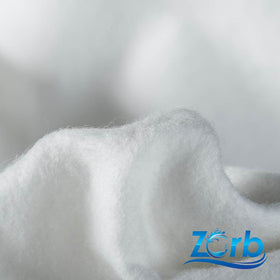
The person who eventually opened the door for them was Denys Redon at Milpoint. Milpoint carries our fabrics in Europe, and the absorbent fabric in that conversation is ours. It is called Zorb. It is Made in USA by AKAS Tex.
So three capable, well-connected women spent the better part of a year looking for something that has been sold by the yard, to anyone who asks, for fifteen years. You can buy a swatch of it for two dollars.
That gap is not their failing. It is the shape of the trade they walked into. Absorbent textiles have historically been treated as inventory rather than knowledge, and the reflex to guard the how runs deep in it.
We have gone the other way, and this seems like the right moment to say why. A mill that sells four hundred thousand yards to an importer never hears what happened to the fabric. We sell to people who tell us everything — what worked, what leaked, what they tried that nobody designed for. That feedback is worth more to us than the secret would be. So we publish what things are made of.
Here is what we would have told them on the first phone call.
The most common reason a first attempt fails is that one fabric is asked to do all three.
Think about wiping up a spill with a paper towel. It soaks up the liquid — but the surface stays wet against your fingers, and if you press down, it comes back through onto your hand. Absorbing is only one of the things you needed it to do.
A reusable pad or a pair of period shorts separates the jobs into layers, in this order:
Skin → wicking face → absorbent core → waterproof barrier → outside
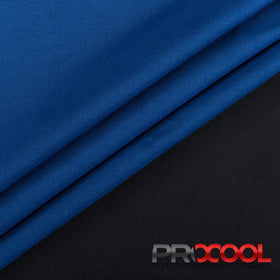
The wicking face moves liquid off the skin and into the core, and keeps the surface dry once the core is loaded. This is ProCool in our range.
The absorbent core captures, spreads and holds. This is Zorb. It takes liquid in in under two seconds, and Zorb Original and Zorb 3D absorb up to around ten times their own weight. The speed matters more than people expect — it is what stops liquid pooling and running off before it is taken in.
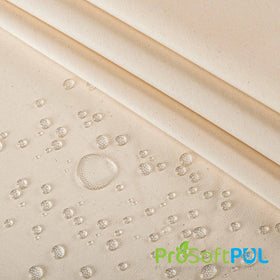
The waterproof barrier stops what the core is holding from going any further. This is ProSoft ECO-PUL, and it is a laminate, not a coating.
A core with no barrier behind it will wet whatever it sits on once it saturates. A core with no wicking face in front will feel wet against the skin under pressure. Neither is a fault in the fabric. It is the stack doing what a stack does when a layer is missing.
Two practical things nobody tells you, and both matter more in a workshop than in a home.
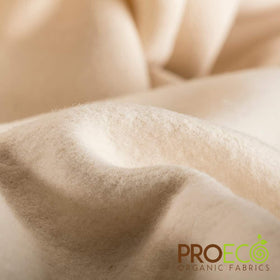
Zorb Original must be enclosed between two fabrics before its first wash. It is an unbonded interlining. Washed with an edge exposed, it comes apart. Enclose it, every time, and it will outlast the pad.
And Zorb arrives ready to absorb. There are no conditioning washes to run first. Where clean water and machine capacity cannot be assumed, a fabric that works from the first cut is not a convenience. It is the difference between the fabric crossing the distance and not.
We should be straightforward about our limits too. Our published figures are fabric-level and carry the ±10% that textile manufacturing carries. We do not test absorption in finished products, so we cannot tell you what a particular pad will hold — that depends on your layers, your weight class, your quilting and how it is worn. Build one, load it, sit on it. And on the Silver Plus variants, the silver inhibits bacterial growth on the fabric between washes. It is a claim about the cloth. It is not a claim about the person wearing it, and it does not replace washing.
In October 2024, a woman in Dayton, Ohio named Dianne Leach bought Zorb Original Silver.
She was making pads for girls in Kenya. In her review she wrote that the girls cannot go to school, and that what they use instead is mud, straw, rags, whatever they can find. Then she did the arithmetic out loud, the way people in this community always seem to:
Fifty yards does one thousand pads. Three each, so that is three hundred and thirty-three girls.
In the box asking for sewing tips, where most people write about needle size, she wrote: careful cutting, and sewing with love in your heart.
She is one of thirty-six makers we can name who have been doing this for years. Donna Terpstra has ordered the barrier fabric from us for twelve unbroken years, for women's empowerment programmes. Gretchen Forbes ordered swatches before she would commit bolts to Days for Girls, and said the small money for swatches was worth it. Teresa chose a dark brown for Operation Christmas Child, because staining would not wash out where those pads were going. Kathleen Tiffin made the same decision independently, years later, for Ghana — and translated our spec into her community's own word for it: bleedproof.
Ethiopia. Guatemala. Ghana. South Sudan. Malawi. Kenya. None of them knew each other. All of them arrived at the same three layers and most of the same decisions, and every one of them sews into a silence — the girl at the far end of the chain cannot write back, and none of them expected her to.
So when we read about three women in Paris spending a year looking for a fabric, what we saw was not a gap in the market. It was a conversation that has been running for over a decade in one place, and starting from zero in another, with nothing connecting the two.
If you are organising a programme, running a workshop, or sewing for a chapter, you do not have to prove anything to us to find out what our fabric is made of. Ask, and we will tell you. Order a swatch before you order a bolt — Gretchen was right about that, and it is the cheapest advice in this whole article.
To Émilie, Anne-Charlotte and Anne, and to the three women in Agadez and the twelve seamstresses working with them: thank you for doing this. The road you took to the fabric was longer than it needed to be, and we would like it to be shorter for the next person who goes looking.
You are not the first. That is not a small thing to be able to say.
Read the original: Précarité menstruelle — À la recherche du tissu magique, by Florence Besson. ELLE France, 20 August 2026.